
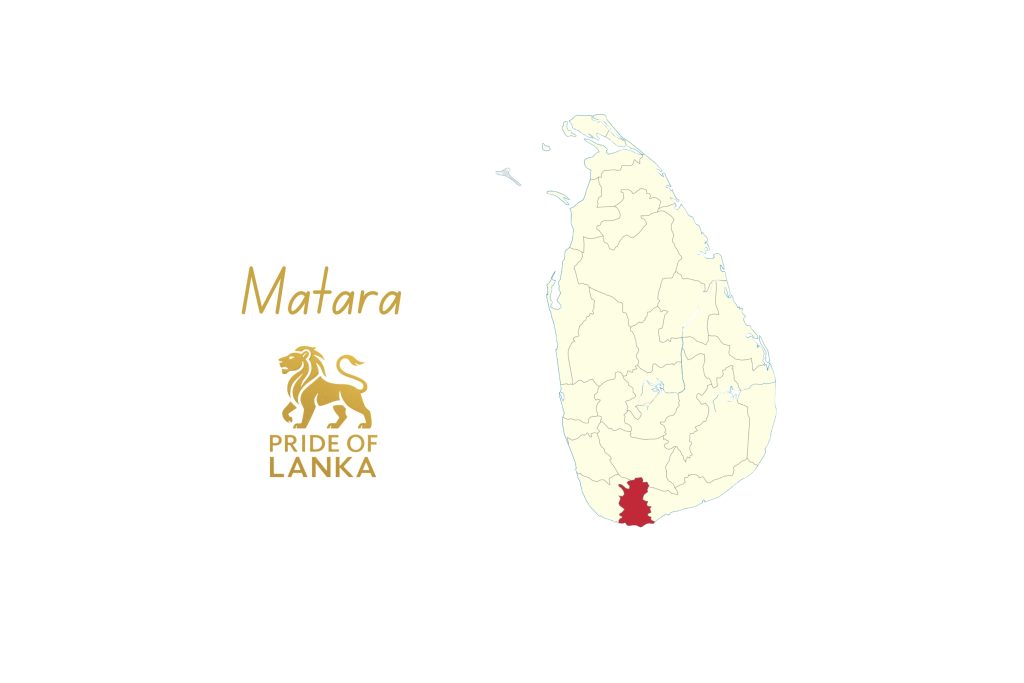
Matara District stands at the southern edge of Sri Lanka, where the island opens fully to the Indian Ocean and where the cultural and intellectual traditions of the deep south have flourished for centuries. Long before modern administrative boundaries, Matara was one of the great cities of southern Sri Lanka, a center of governance, trade, religion, and scholarship.
Today, Matara remains a major urban, cultural, and economic hub of the Southern Province, combining coastal life, inland agriculture, historic monuments, and modern education.
A City Built on the Nilwala River
The Nilwala River flows through the heart of Matara and has shaped the district’s geography, economy, and settlement patterns for generations. Its fertile basin supports paddy cultivation, coconut, and mixed agriculture, while the river itself has long served as a transport and trade route between the interior and the coast.
The old city of Matara developed around this river-mouth, making it one of the most important ports and administrative centers of the south.
Forts, Kings, and Colonial Layers
Matara has a long and layered history. It was an important city during the time of the ancient Ruhuna kingdom and later became a key stronghold under Portuguese, Dutch, and British rule.
The Matara Fort, built by the Dutch, still stands today as one of the best preserved colonial fortifications in southern Sri Lanka, reminding visitors of the district’s strategic importance in the Indian Ocean world.
The district is also rich in Buddhist heritage, including important temples such as Weherahena, known for its massive seated Buddha statue and underground temple complex.
A Cradle of Southern Learning and Literature
Matara and the wider southern region have played a major role in shaping modern Sinhala literature, journalism, education, and social thought. The district has produced many of Sri Lanka’s most influential writers, poets, monks, scholars, and public intellectuals.
Institutions such as the University of Ruhuna have strengthened Matara’s position as one of the country’s leading centers of higher education, research, and cultural life outside Colombo.
The Coast, the Sea, and Southern Livelihoods
Matara’s coastline is long, beautiful, and economically vital. Fishing, boat-building, and marine-based livelihoods remain central to many communities along the coast.
The district is also close to some of Sri Lanka’s most famous beaches and coastal attractions, including Mirissa, Polhena, and the wider southern surf and whale-watching belt.
The deep-sea port of Dondra, near the southernmost point of Sri Lanka, has for centuries marked Matara’s role in Indian Ocean navigation and maritime life.
Agriculture and Rural Landscapes
Beyond the coastal belt, Matara includes fertile inland areas that support paddy cultivation, coconut, tea, and mixed farming. The combination of river valleys, coastal plains, and gentle hills makes the district one of the more agriculturally balanced regions of the south.
A District Looking Forward
Matara has strong potential in:
- Education and knowledge-based development
- Coastal and marine tourism, including whale watching
- Agro-processing and value-added agriculture
- Cultural and heritage tourism
- Fisheries and marine industries
With its universities, port access, and regional connectivity, the district is well positioned to play a larger role in southern Sri Lanka’s development in the years ahead.
Pride of Lanka Perspective
Matara is a district of depth and dignity. It carries the intellectual confidence of the south, the rhythms of the sea, and the continuity of a river-based civilization.
It reminds Sri Lanka that some of the country’s strongest cultural foundations were built far from capitals, in cities that combined learning, trade, and tradition.
In celebrating Sri Lankan excellence, Matara stands as the southern capital of memory, knowledge, and enduring coastal life.