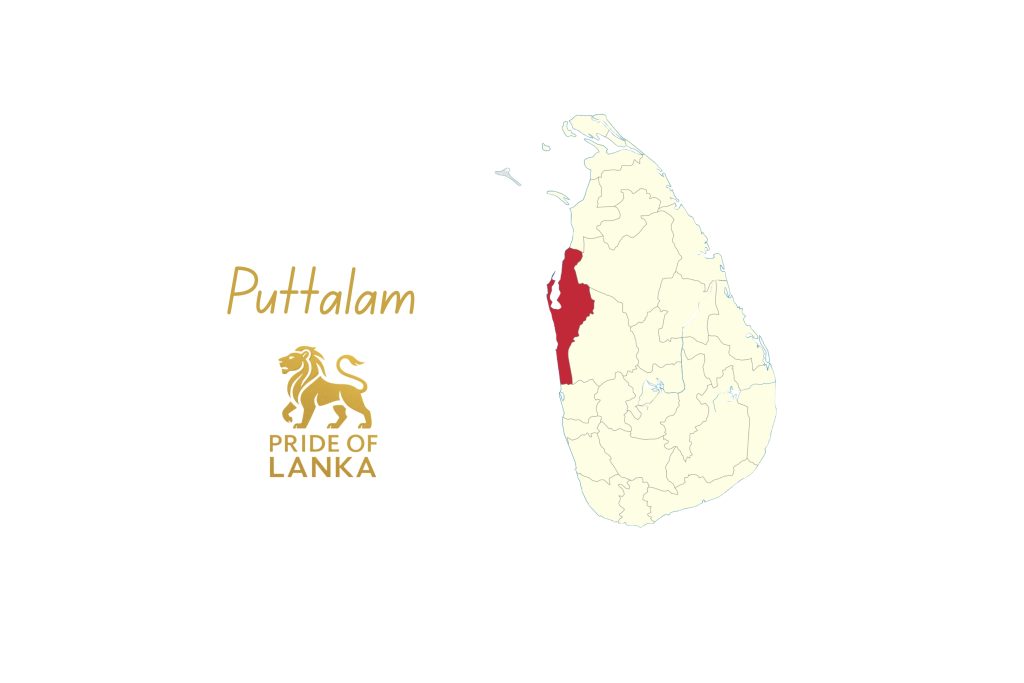
Puttalam District stands at the meeting point of Sri Lanka’s western coast and the north western dry zone interior, forming one of the country’s most diverse and strategically important regions. With long coastlines, vast lagoons, salt plains, coconut estates, and dry zone farming lands, Puttalam is a district shaped by water, sun, wind, and trade.
Often overlooked in national narratives, Puttalam quietly supports some of Sri Lanka’s most important industries and ecological systems.
A Landscape of Lagoons, Sea, and Dry Zone Plains
Puttalam’s geography is dominated by the Puttalam Lagoon, one of the largest lagoons in Sri Lanka, stretching across much of the district and supporting fisheries, aquaculture, and coastal livelihoods.
The district includes long coastal belts, sandy plains, salt flats, and inland dry zone farming areas. This mix of ecosystems makes Puttalam one of the most environmentally varied districts in the country.
The region also lies close to important wildlife and wetland systems, including Wilpattu National Park, one of Sri Lanka’s largest and oldest protected areas.
The Coconut Triangle and Agricultural Backbone
Puttalam forms part of Sri Lanka’s famous coconut triangle, together with Kurunegala and Gampaha. Coconut cultivation dominates much of the district’s agricultural landscape and supports a wide range of industries, from oil and coir to food products and exports.
Inland areas also produce paddy, onions, chillies, and other field crops, especially under irrigation based farming systems.
Salt, Fisheries, and Coastal Industries
Puttalam is one of Sri Lanka’s main centers of salt production. The salt pans around Puttalam and nearby areas are a familiar sight and play a vital role in the country’s food industry.
Fishing and lagoon based livelihoods support thousands of families, with both marine and brackish water fisheries forming an important part of the local economy.
The district also has long experience in boat building, fish processing, and coastal trade.
Energy and Industry
Puttalam occupies a special place in Sri Lanka’s modern energy map. The Norochcholai coal power plant, located on the coast, is one of the country’s largest power generation facilities and plays a major role in national electricity supply.
In addition, the district has growing potential in renewable energy, especially wind and solar, due to its strong coastal winds and open dry zone landscapes.
A District of Many Communities
Puttalam is one of Sri Lanka’s most ethnically and religiously diverse districts. Sinhalese, Muslims, Tamils, and Catholic communities live across the district, shaping its culture, food traditions, religious life, and social fabric.
The district has a strong Muslim and Catholic heritage in many coastal towns, alongside Buddhist and Hindu communities inland, reflecting centuries of trade, migration, and settlement.
History, Trade, and Coastal Towns
Puttalam has long been part of Sri Lanka’s coastal trade networks. Towns along the lagoon and coast served as ports and trading points connecting the island with South India and the wider Indian Ocean world.
Churches, mosques, temples, and old settlements across the district tell the story of these layered connections.
Tourism, Nature, and Future Potential
Puttalam has strong and still underdeveloped potential in:
- Lagoon and eco tourism
- Wilpattu and wildlife tourism
- Beach and coastal tourism
- Renewable energy development
- Agro processing and salt based industries
Its wide open landscapes and quiet coastlines offer a very different experience from the more crowded southern and western beaches.
Pride of Lanka Perspective
Puttalam is a district of elements. Sun, wind, salt, water, and earth come together here to sustain livelihoods and power the country.
It reminds Sri Lanka that national strength is not built only in cities and monuments, but also in working landscapes that feed, fuel, and support everyday life.
In celebrating Sri Lankan excellence, Puttalam stands as a symbol of diversity, quiet productivity, and the strategic importance of regions that often work behind the scenes.