
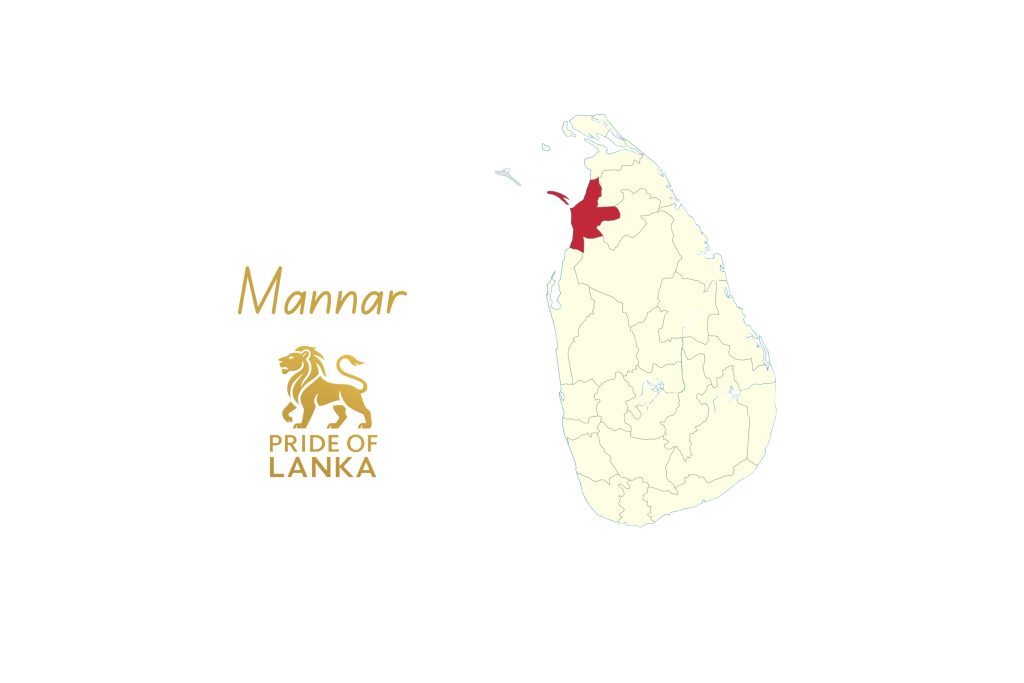
Mannar District stands at Sri Lanka’s northwestern edge, where the Indian Ocean narrows toward South India and history feels unusually close. Defined by sea, salt, wind, and wide horizons, Mannar has for centuries been a gateway between the island and the subcontinent, a place of trade, faith, and movement long before modern borders existed.
Today, Mannar is known for its unique island geography, deep religious significance, rich marine resources, and remarkable ecological landscapes, as well as for the resilience of its communities.
A Geography Shaped by Sea and Sand
Mannar is centered on Mannar Island and connected to the mainland by a narrow causeway. The district’s landscape is dominated by flat coastal plains, lagoons, sandbanks, and shallow seas, creating a very different environment from most other parts of Sri Lanka.
The coastline and surrounding waters are rich in marine life and have traditionally supported fishing, pearl oysters, and salt-based livelihoods. The dry climate and open terrain give Mannar a distinctive, almost Mediterranean character within the Sri Lankan context.
The Ancient Bridge Between Lands
One of Mannar’s most famous natural features is Adam’s Bridge, also known as Rama’s Bridge, a chain of shoals and sandbanks stretching between Sri Lanka and India. For centuries, this natural formation has captured the imagination of geographers, historians, and pilgrims, and it symbolizes Mannar’s role as a historic bridge between civilizations.
Mannar has long been part of Indian Ocean trade networks, connecting Sri Lanka with South India and beyond, especially in pearls, conch shells, and other marine products.
Faith, Pilgrimage, and Shared Sacred Space
Mannar holds a special place in Sri Lanka’s religious landscape. The island of Madhu, home to the Shrine of Our Lady of Madhu, is one of the most important Catholic pilgrimage sites in South Asia, visited by hundreds of thousands of devotees each year from all communities.
At the same time, the district also contains important Hindu and Buddhist religious sites, reflecting a long tradition of shared sacred geography and religious coexistence.
A Land of Baobabs, Birds, and Biodiversity
Mannar is one of Sri Lanka’s most ecologically distinctive regions. It is famous for its baobab trees, believed to have been brought by Arab traders centuries ago, which today stand as living monuments to the district’s maritime connections.
The wetlands, lagoons, and coastal plains of Mannar form one of the most important bird habitats in the country, hosting large numbers of resident and migratory birds. Parts of the district are recognized internationally for their ecological value and biodiversity.
People, Memory, and Renewal
Mannar, like much of the Northern and North Western border regions, has endured years of conflict, displacement, and hardship. Many communities were uprooted, and normal life was disrupted for a long time.
Today, the district is in a phase of rebuilding and renewal. Fishing, farming, trade, and small businesses are gradually strengthening again, and communities are working to restore both livelihoods and social life.
The population is largely Tamil, with a strong Catholic presence, and village life, churches, temples, and schools play a central role in community organization.
Economy and New Horizons
While fishing remains the backbone of the coastal economy, Mannar has growing potential in:
- Fisheries and marine-based industries
- Renewable energy, especially wind and solar
- Eco and birding tourism
- Salt production and dry-zone agriculture
- Cross-regional trade and logistics
The strong coastal winds of Mannar have already made it one of Sri Lanka’s key regions for wind power development.
Pride of Lanka Perspective
Mannar is a district of horizons and crossings. It is where land almost meets another land, where faith draws people together, and where nature shows a different face of Sri Lanka.
It reminds the country that identity is shaped not only by mountains and cities, but also by seas, winds, and ancient routes of connection.
In celebrating Sri Lankan excellence, Mannar stands as a symbol of openness, endurance, and the quiet strength of a place that has always lived between worlds.