
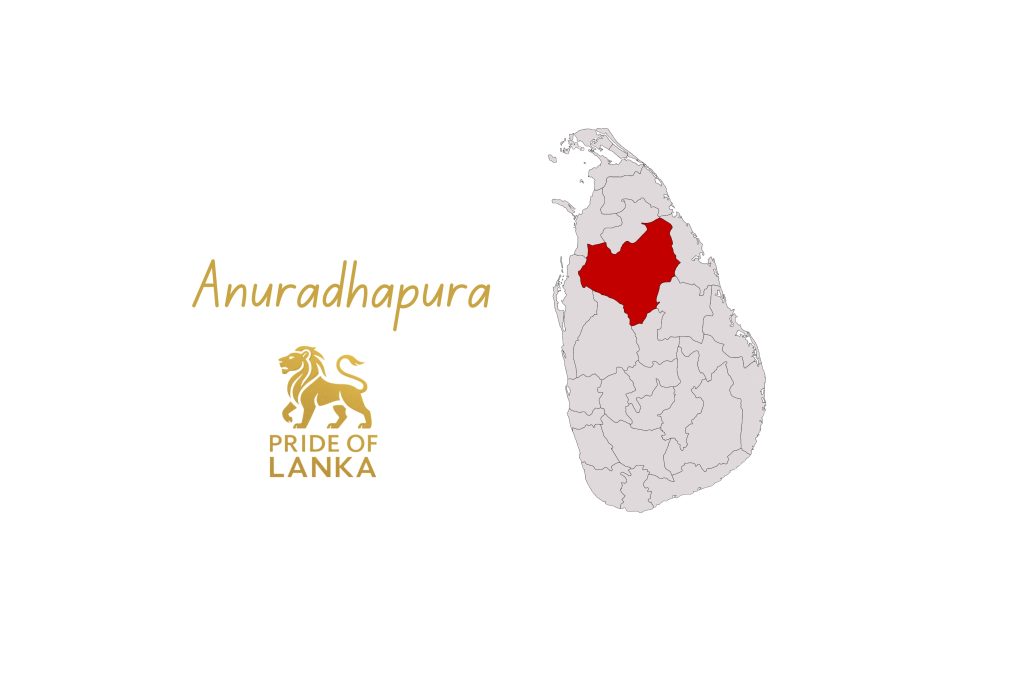
Anuradhapura is not merely a district or an ancient city. It is the cradle of Sri Lanka’s civilization, the spiritual heart of the nation, and one of the greatest living heritage cities in Asia. For over a millennium, Anuradhapura served as the capital of Sri Lanka, shaping the island’s political systems, hydraulic engineering, Buddhist culture, and civilizational identity.
Today, Anuradhapura District stands as both a UNESCO World Heritage City and one of Sri Lanka’s most important agricultural and cultural regions, where living tradition, monumental history, and modern rural life coexist in a unique and powerful harmony.
The Birthplace of a Hydraulic Civilization
Anuradhapura is the foundation of Sri Lanka’s world-famous ancient irrigation and tank civilization. The district is surrounded by a network of massive reservoirs such as Nuwara Wewa, Tissa Wewa, Abhaya Wewa, Kala Wewa, and the great Yoda Ela canal system, engineering marvels that still function after more than 1,500 years.
These systems transformed the dry zone into a productive agricultural heartland and established Sri Lanka as one of the greatest hydraulic civilizations of the ancient world. Even today, Anuradhapura remains one of the country’s most important rice-producing regions and a pillar of national food security.
The Sacred City and Living Buddhism
Anuradhapura is one of the holiest cities in the Buddhist world. The Sri Maha Bodhi, grown from a sapling of the very tree under which the Buddha attained Enlightenment, is the oldest documented living tree in the world with a recorded history. It continues to be worshipped daily by pilgrims from across Sri Lanka and the world.
The city is also home to some of the most iconic monuments of ancient Asia, including Ruwanwelisaya, Jetavanaramaya, Abhayagiriya, and Mirisavetiya stupas. Jetavanaramaya, once among the tallest structures in the ancient world, stands as a testament to the technological and architectural sophistication of early Sri Lankan civilization.
The Abhayagiriya and Mahavihara monastic complexes were not only religious centers but also international universities of their time, attracting scholars from India, China, and across Asia.
A Crossroads of Asian History
For centuries, Anuradhapura was a hub of diplomacy, trade, and intellectual exchange. The city maintained relations with South India, Southeast Asia, and even the Mediterranean world. Chinese monks such as Faxian recorded their journeys to Anuradhapura, describing it as a grand, prosperous, and deeply spiritual metropolis.
The district therefore represents not only Sri Lanka’s national heritage, but also the island’s historic place within the wider Asian civilizational network.
People Who Shaped the Nation
Anuradhapura is inseparable from the legacy of Sri Lanka’s greatest kings. Devanampiya Tissa, who introduced Buddhism to Sri Lanka; Dutugemunu, the unifier of the island; and Valagamba, who oversaw the preservation of the Buddhist scriptures, are all deeply associated with this sacred capital.
In modern times, the district and the broader North Central Province have produced statesmen, administrators, scholars, engineers, and military leaders who have played key roles in national development, irrigation, agriculture, and public administration.
Nature, Wildlife, and Living Landscapes
Beyond its monuments, Anuradhapura is surrounded by forests, tanks, and wildlife corridors. The district lies close to major protected areas and elephant habitats, making it part of Sri Lanka’s central wildlife landscape.
The tank-based village system, where agriculture, water, forest, and settlement exist in balance, continues to operate much as it did in ancient times, offering the world a living example of sustainable civilization.
A Modern Administrative and Development Hub
Today, Anuradhapura serves as the administrative capital of the North Central Province and is a major center for education, healthcare, agriculture, and public administration. Institutions such as the Rajarata University have strengthened its role as a regional knowledge hub.
The district has strong potential for:
- Heritage and spiritual tourism
- Agro-industry and food processing
- Renewable energy, especially solar
- Research in archaeology, history, and sustainable water management
- Cultural and educational tourism
Pride of Lanka Perspective
Anuradhapura is not a city of ruins. It is a living civilizational capital. It is where Sri Lanka learned to govern, to farm, to build, to preserve knowledge, and to live with water and nature in harmony. To understand Sri Lanka, one must understand Anuradhapura. And to imagine Sri Lanka’s future, one must rediscover the wisdom embedded in this sacred landscape.
In celebrating Sri Lankan excellence, Anuradhapura stands not only as a memory of past greatness, but as a guide to what the nation can become again.